Case Study: Optimizing Acoustic Isolation and Reverb Control for Grand Horizon Cinema Complex
I. Project Overview
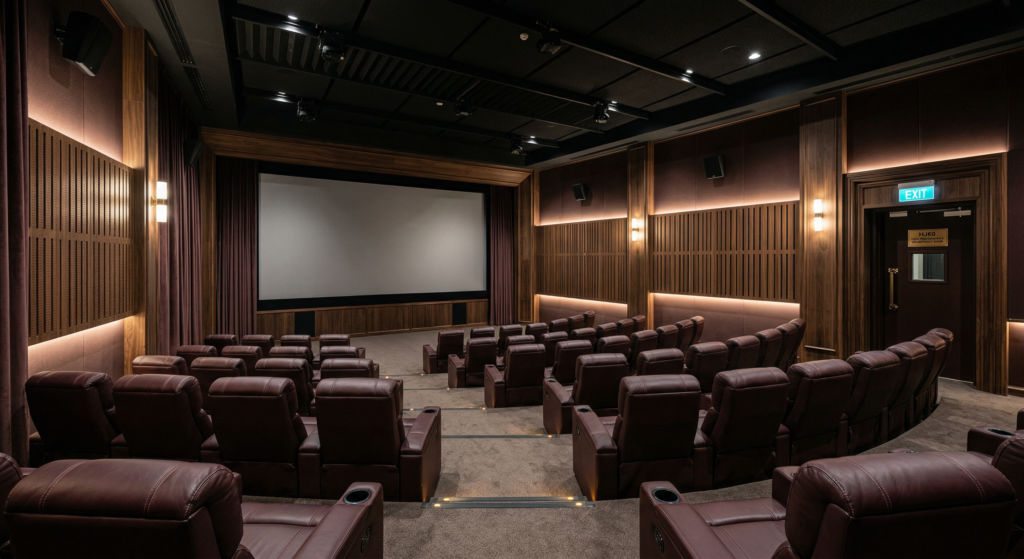
Project Name: Grand Horizon Luxury Cinema Acoustic Retrofit Location: Singapore Project Scale: 12 High-Definition Screening Halls (including 2 IMAX-ready theaters) Core Objective: To eliminate sound leakage between adjacent theaters and achieve a precise reverberation time (RT60) for a premium immersive audio experience.
——————————————————————————–
II. The Challenge
The Grand Horizon Cinema faced two primary acoustic hurdles. First, the “sound bleeding” issue: low-frequency vibrations from high-action blockbusters were leaking into adjacent halls through the entry points. Second, the internal acoustics suffered from excessive mid-to-high frequency reflections, which blurred the clarity of the cinema’s state-of-the-art surround sound systems.
——————————————————————————–
III. The SOUNDTEC Solution: A Technical Breakdown
To address these challenges, SOUNDTEC Design implemented a dual-layer strategy focusing on High-Performance Isolation and Scientific Absorption.
1. Structural Isolation: HJ60 High-End Soundproof Doors
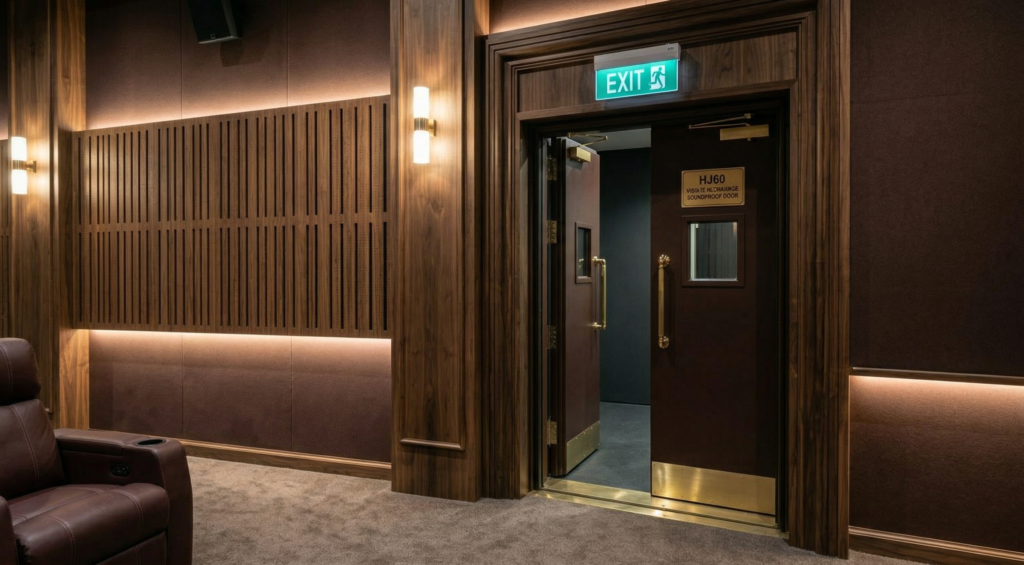
The theater entrances were fitted with HJ60 High-End Soundproof Doors, customized with a natural wood veneer to match the luxury interior.
- Multi-Layer Composite Core: The 60mm thick door leaf features a multi-layer high-density metal composite core specifically engineered to block a wide frequency spectrum.
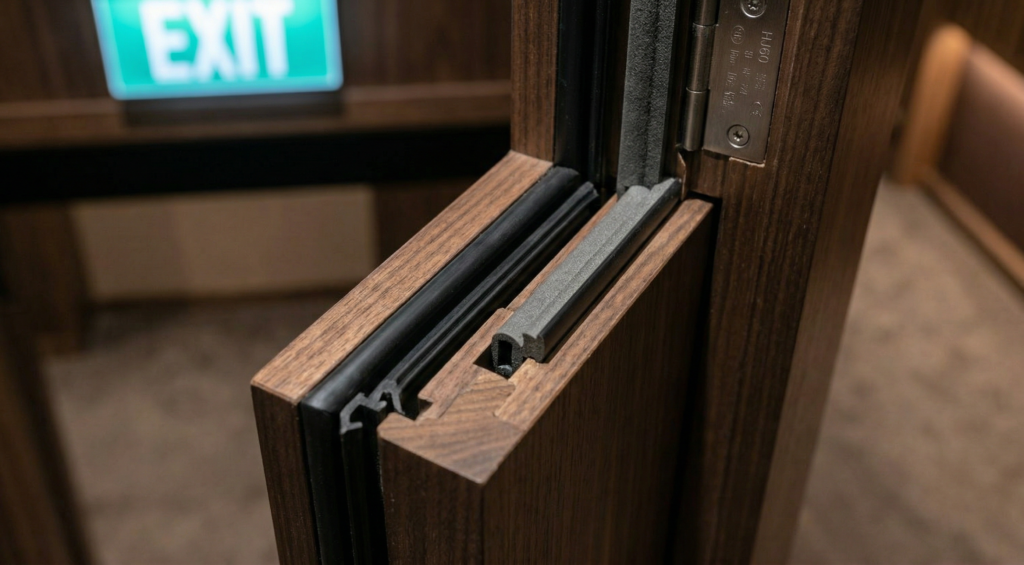
- Double-Tooth Sealing System: A critical technical feature used was the independently developed Double-tooth soundproof sealing system. This dual-material sealing strip, formed by integrating different densities and hardnesses, ensures that the door remains airtight under pressure, effectively achieving an isolation volume of 43dB(±2).
- Pneumatic & Mechanical Precision: Each door was equipped with a superior pneumatic lock and heavy-duty hydraulic hinges to maintain the integrity of the acoustic seal over thousands of uses.
2. Internal Acoustic Tuning: Slotted Acoustic Panels
For the interior walls, SOUNDTEC deployed Slotted Acoustic Panels to control the sound field.
- Frequency-Specific Absorption: Based on the cinema’s specific dimensions, the Standard Model 13/3 (perforation rate 12.8%) was selected. This model offers an exceptional sound absorption coefficient of 0.91 at 500Hz and 0.68 at 1000Hz, which is ideal for capturing the mid-to-high range frequencies prevalent in cinematic dialogue and soundtracks.
- Scientific Configuration: The structure—consisting of the base material, finish, and a specialized acoustic backing—was installed using a cavity mounting method to further enhance low-frequency absorption through the Helmholtz resonance principle.
- Safety & Aesthetics: The panels used a Red Core Flame Retardant substrate, meeting Class B1 fire performance standards required for high-occupancy public spaces.
——————————————————————————–
IV. Technical Performance Results
Post-installation acoustic testing revealed significant improvements:
- Isolation Integrity: Sound leakage between the loudest action hall and the quietest drama hall was reduced below the ambient noise floor, thanks to the 43dB rated HJ60 doors.
- Reverb Optimization: The RT60 was successfully stabilized within the target range (0.3s – 0.5s for mid-frequencies), significantly enhancing the “sweet spot” for the audience.
——————————————————————————–
V. Maintenance & Best Practices
To ensure the long-term acoustic performance of the installation, the following protocols were established:
- Seal Integrity: Regular inspection of the Double-tooth sealing strips on the HJ60 doors to ensure no debris compromises the airtightness.
- Surface Care: The Technical Wood Veneer on the slotted panels should be cleaned with specialized non-abrasive agents to maintain its finish without clogging the micro-perforations.
Conclusion
By integrating high-performance HJ60 Soundproof Doors with scientifically engineered Slotted Acoustic Panels, SOUNDTEC Design transformed Grand Horizon Cinema into a benchmark for acoustic excellence, proving that “acoustic comfort” and “spatial aesthetics” can coexist seamlessly.